How it works
A message passes through contracts on two chains and two kinds of off-chain agent. Validators attest that it was sent; the relayer carries that proof to the destination, where a security module checks it.
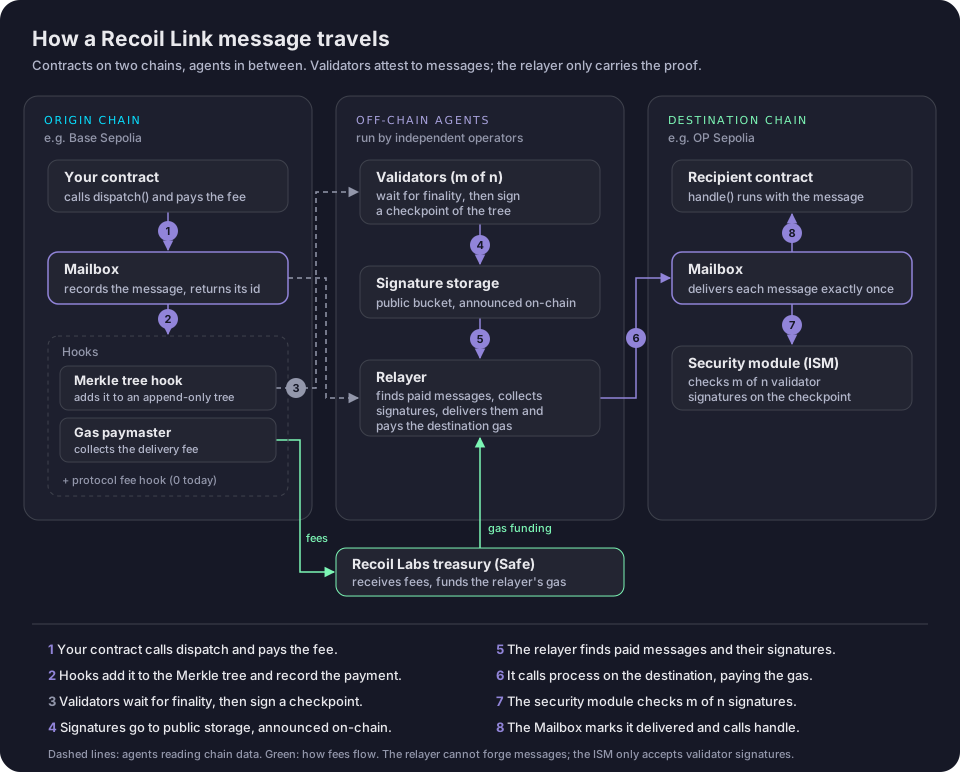
Step by step, every message goes through the same five stages:
- Dispatch. Your contract calls
dispatchon its chain's Mailbox with the destination domain, the recipient and the message body, paying the quoted fee. The Mailbox returns amessageId. - Hooks. The Mailbox runs its hooks: the Merkle tree hook adds the message to an append-only tree, and the interchain gas paymaster (IGP) records the gas payment.
- Attestation. Validators watch the Mailbox and sign checkpoints (the Merkle root and the latest message) once the origin block is final enough. Signatures are published to storage the relayer can read.
- Delivery. The relayer picks up messages that paid for gas, collects enough validator signatures, and calls
processon the destination Mailbox, paying the destination gas itself. - Verification and handling. The destination Mailbox asks the recipient's interchain security module (ISM) to verify the signatures. If they pass, it marks the message delivered (exactly once) and calls the recipient's
handle.
Domains
Chains are identified by a domain id (uint32). For every EVM chain Recoil Link supports, the domain id equals the chain id: Sepolia is 11155111, Base Sepolia 84532. See Networks.
Addresses as bytes32
Senders and recipients are bytes32, so non-EVM chains fit. An EVM address is left-padded with zeros:
bytes32 recipient = bytes32(uint256(uint160(recipientAddress)));
Timing
On testnet, delivery takes 20–140 seconds. Most of it is the origin chain's finality: validators sign only after the block is final enough not to be reorganised (BSC testnet waits longest).
Who pays
The sender pays once, on the origin chain, in its native token: destination gas plus margin (see Gas and fees). Recoil Labs' relayer pays the destination gas. The fee goes to the gas paymaster, whose beneficiary is the Recoil Labs treasury, and the treasury funds the relayer (see Operators). The recipient pays nothing.